 AgileKoc Tools
Scrum Quiz Guide
Why People Fail Scrum Exams (and How to Fix It)
The most common mistakes—and a practical fix for each.

Why smart people still fail
Scrum exams don’t punish you for not knowing a definition. They punish you for missing the intent behind the question.
That’s why smart, experienced people still fail PSM/PSPO-style exams: they read a scenario, see a familiar keyword (“Sprint Goal,” “impediment,” “Backlog refinement”), and answer from habit instead of reasoning from Scrum’s rules and accountabilities.
This guide covers the three mistakes I see most often—and what actually fixes them in a practical, repeatable way.
Mistake #1: Memorizing instead of understanding
What it looks like: You can recite the roles and events, but when the exam asks a scenario question—especially with two “almost correct” options—you freeze or pick the most familiar wording.
Why it happens: Scrum exams (especially Scrum.org style) are scenario-heavy. They’re not trying to confirm you read a glossary. They want to see if you can:
- apply the Scrum Guide in messy reality,
- spot “project management habits” disguised as Scrum,
- and choose the option that best protects transparency, inspection, and adaptation.
Typical wrong-thinking pattern
“I remember Scrum Master removes impediments… so they should do X.”
But the scenario is actually about who is accountable or who decides.
1000+ Question Offline Scrum Exam Simulator
Real exam experience for PSM I and PSPO I preparation. Difficulty levels, topic selection, timer, and detailed explanations.
Not an official Scrum.org product. Independent practice tool.
Fix: Translate every rule into real team behavior
Instead of memorizing: “The Product Owner orders the Product Backlog.” Translate it into behavior:
- When priorities change, the PO decides the order.
- Developers can propose changes, but they don’t approve priority.
- The PO doesn’t need permission to reorder items.
Now the exam becomes easier
When you see a scenario, ask:
- What behavior does Scrum expect here?
- Which option best matches accountability and intent?
Practical exercise (10 minutes/day)
For each rule you learn, write:
- The rule in one line
- A real behavior it implies
- A small scenario question you could ask yourself
Example
That’s how you build “exam intuition” without guessing.
- Rule: “Sprint Backlog is a plan by and for the Developers.”
- Behavior: “Developers decide how to accomplish the Sprint Goal; others don’t assign tasks.”
- Scenario: “A manager breaks down work and assigns tasks mid-sprint. What should happen?”
Mistake #2: Role confusion (accountability traps)
Most incorrect answers come down to mixing accountabilities.
Scrum questions love situations where someone tries to do the right thing but picks the wrong owner:
- PO acting like a team manager
- Scrum Master acting like a project manager
- Developers acting like backlog owners
The core role truths (simple but decisive)
Product Owner:
- Orders the Product Backlog to maximize value
- Owns value outcomes and priority decisions
- Makes trade-offs visible
- Common trap: “The PO assigns work to Developers.”
Scrum Master
That’s project management behavior. Scrum Master protects the process and helps the team improve—not command-and-control.
- Coaches Scrum, removes impediments, improves effectiveness
- Facilitates events as needed
- Helps the organization understand Scrum
- Common trap: “Scrum Master manages the team, assigns tasks, approves estimates, enforces deadlines.”
Developers
They can suggest and negotiate, but the PO orders it.
- Create the Increment
- Plan and own the Sprint Backlog
- Manage the work day-to-day
- Common trap: “Developers can change the Product Backlog priority.”
Fix: Build a one-page accountability map
When you do practice questions, force yourself to label the scenario first:
Then answer. This single step eliminates a huge chunk of wrong answers.
- This is about Product Backlog ordering → PO
- This is about Sprint Backlog and plan → Developers
- This is about coaching/facilitation/impediments → Scrum Master
Real exam-style example
Stakeholders request a change mid-sprint. Who decides what happens?
Better reasoning: PO negotiates scope while protecting Sprint Goal; Developers adapt the plan and update Sprint Backlog; Scrum Master helps facilitate, not decide the content.
Mistake #3: No feedback loop (repeating the same errors)
What it looks like: You do 200 questions, score 70%, then do another 200, and you’re still stuck around 70–75%. That’s not lack of effort—it’s lack of a learning loop.
Why it happens: People treat wrong answers like a temporary failure instead of valuable data. They move on too fast and don’t track weak topics.
Fix: Track weak topics, re-test them, and review every incorrect choice
You don’t need a complicated system. You need consistency.
Simple feedback loop (works):
- After every quiz, list 3 weak topics (e.g., Sprint Backlog ownership, Review purpose, refinements, empiricism)
- Re-test only those topics within 24–48 hours
- For each wrong answer, write one sentence: “I chose this because…, but Scrum expects…, therefore…”
Extra tip
Don’t just read the explanation for the correct answer. Ask: “Why are the other choices wrong?”
Exams often include “almost correct” options that are wrong for one key reason (wrong owner, wrong event purpose, violates empiricism).
A practical study routine (that actually improves your score)
If you want a realistic plan that avoids burnout:
Do this for 10–14 days and you’ll feel your score stabilize higher because you’re building a real feedback loop, not just grinding questions.
- 20–30 minutes per day
- 10 minutes: one topic review (roles/events/artifacts/values/theory)
- 15 minutes: 15–25 scenario questions
- 5 minutes: review wrong answers + write your “therefore” sentence
Quick self-check: Are you exam-ready?
If you can do these consistently, you’re ready to perform under exam pressure.
- Explain why the correct option is correct in a scenario
- Identify which accountability the question is testing
- Say why tempting wrong options are wrong (not just “because the guide says so”)
- Keep a small list of weak topics and re-test them until they stop being weak
Final reminder
Scrum exams reward clarity: clear purpose of events, clear ownership of accountabilities, and a clear learning loop when you get it wrong.
Memorization gets you started. Understanding gets you certified.
1000+ Question Offline Scrum Exam Simulator
Real exam experience for PSM I and PSPO I preparation. Difficulty levels, topic selection, timer, and detailed explanations.
Not an official Scrum.org product. Independent practice tool.
Haftalık Agile İpuçları + Ücretsiz PDF
Sprint’te görünür etki yaratmak için kısa ve uygulanabilir ipuçları. İlk e-postada “Scrum Master Etki Panosu” PDF’i (TR/EN).
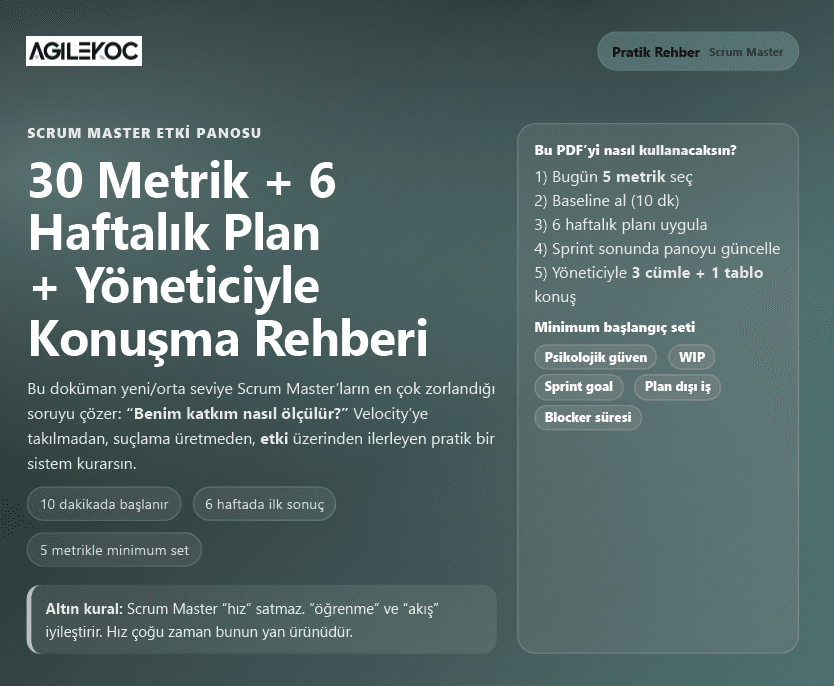
Scrum Master olarak katkını nasıl kanıtlarsın?
Velocity’ye takılmadan: 5 metrik + 6 haftalık planla görünür etki hikayesi çıkar.
- - 5 metriklik etki panosu
- - 6 haftalık uygulama planı
- - Yöneticiye anlatım şablonu
Gizliliğine saygı duyuyoruz. E-postanı sadece PDF ve haftalık ipuçları için kullanırız.
Spam yok. İstediğin an çıkabilirsin.
Related guides


Keep practicing
Take the free quiz for instant feedback or unlock the premium simulator for deeper practice.