 AgileKoc Tools
Scrum Quiz Guide
Free Scrum Quiz (10 Questions) + Answer Explanations
Use this 10-question quiz as a diagnostic, then reinforce with targeted practice.

Why this quiz works
If you’re preparing for Scrum exams (PSM / PSPO style) or you simply want to check whether your Scrum knowledge is usable in real scenarios, a short quiz is one of the fastest ways to find gaps.
Not “gaps” like missing a definition—gaps like role confusion, event purpose confusion, or picking the option that sounds nice but breaks Scrum accountabilities. Those are exactly the mistakes that cost points in scenario-heavy exams.
This free 10-question Scrum quiz is designed to work as a diagnostic: take it once, see what you miss, then practice the weak areas with purpose.
What you get in the free quiz
This isn’t meant to be a full exam simulator. It’s a quick, high-signal check you can finish in a few minutes.
✅ 10 role-based questions (high impact topics)
Questions focus on the areas most people misunderstand:
- Product Owner vs Scrum Master accountabilities
- Developers’ ownership of the Sprint Backlog
- Event purpose traps (Review vs Retro, Planning vs Daily Scrum)
- Artifacts and transparency
1000+ Question Offline Scrum Exam Simulator
Real exam experience for PSM I and PSPO I preparation. Difficulty levels, topic selection, timer, and detailed explanations.
Not an official Scrum.org product. Independent practice tool.
✅ Instant score (fast feedback)
You immediately see whether your understanding is steady—or only works when the wording is familiar.
✅ Answer explanations (so you learn, not just score)
Explanations don’t just say “this is the right answer.” They reinforce:
- what rule the wrong answers break
- which accountability is being tested
- how this shows up in real teams
Who this quiz is for
This quiz is especially useful if you:
- keep scoring around 65–80% and can’t break through
- feel confident in definitions but struggle with scenarios
- mix up who decides what (Product Backlog vs Sprint Backlog)
- want a quick warm-up before deeper practice
If you’re already scoring 90%+
This still works as a “sanity check,” but it’s mainly a gap-finder.
What to do right after you finish (the part that actually improves you)
Most people take quizzes like entertainment: score, shrug, move on. That’s how you stay stuck.
A better approach: small, repeated practice with feedback.
1) Review every incorrect answer (no skipping)
For each wrong answer, write one sentence:
“I picked X because…, but Scrum expects…, therefore…”
That “therefore” is the learning hook.
2) Note the rule or accountability it breaks
Examples:
- PO orders Product Backlog, not Scrum Master.
- Developers own the Sprint Backlog and plan the work.
- Sprint Review is about inspecting the Increment with stakeholders, not status reporting.
- Retro is about improving how we work, not explaining what happened.
3) Retake the quiz with a different role focus
Answer the same questions while thinking like a Product Owner, Scrum Master, and Developer. Many wrong answers happen because you answer from the wrong perspective.
4) Set a timer and aim for a steady pace
Time pressure changes how you read. Practice with a timer so you learn to slow down on tricky scenarios and avoid keyword-reflex answers.
A good starting target: 30–45 seconds per question, steady pace, no rushing.
5) Keep a short list of weak topics (3 items max)
Don’t create a huge study plan. Keep it lean:
- Weak topic #1
- Weak topic #2
- Weak topic #3
Then do targeted practice
Practice only those weak topics until they stop being weak. This is how your score climbs.
Sample questions (preview)
You’ll see full explanations inside the quiz experience.
- Who is accountable for ordering the Product Backlog? (Common trap: confusing accountability with “who writes tickets” or “who manages the team.”)
- What is the primary purpose of the Sprint Retrospective? (Common trap: treating it as a status meeting or a blame session.)
- Which artifact makes work transparent for stakeholders? (Common trap: mixing artifacts, or assuming “reports” are Scrum artifacts.)
How to get the most value from a 10-question quiz
A short quiz is only powerful if you treat it like a diagnostic tool:
Do that, and a “small” quiz becomes a real learning engine.
- Take it once cold (no notes)
- Review wrong answers immediately
- Retake it in 24–48 hours
- Practice weak topics until they stop being weak
1000+ Question Offline Scrum Exam Simulator
Real exam experience for PSM I and PSPO I preparation. Difficulty levels, topic selection, timer, and detailed explanations.
Not an official Scrum.org product. Independent practice tool.
Haftalık Agile İpuçları + Ücretsiz PDF
Sprint’te görünür etki yaratmak için kısa ve uygulanabilir ipuçları. İlk e-postada “Scrum Master Etki Panosu” PDF’i (TR/EN).
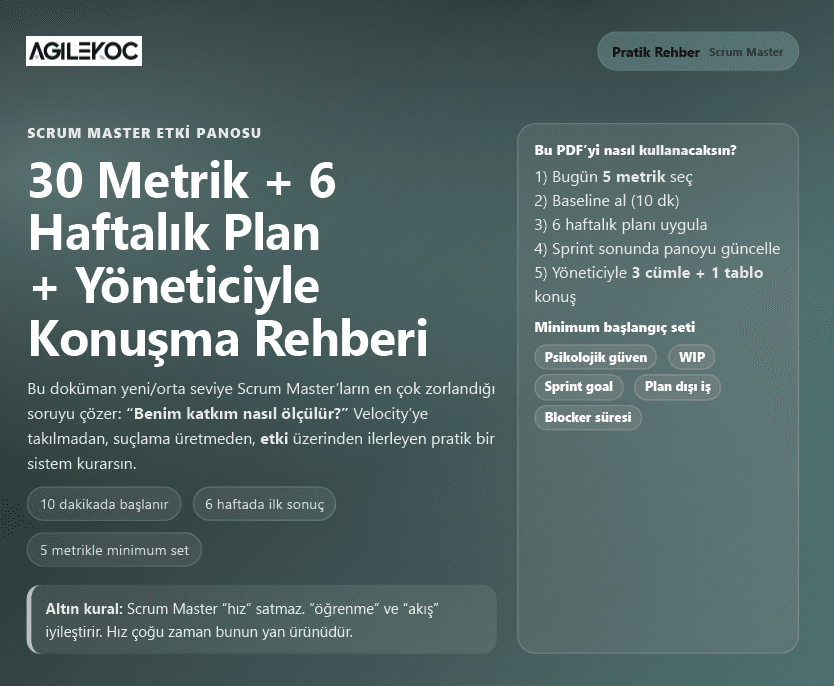
Scrum Master olarak katkını nasıl kanıtlarsın?
Velocity’ye takılmadan: 5 metrik + 6 haftalık planla görünür etki hikayesi çıkar.
- - 5 metriklik etki panosu
- - 6 haftalık uygulama planı
- - Yöneticiye anlatım şablonu
Gizliliğine saygı duyuyoruz. E-postanı sadece PDF ve haftalık ipuçları için kullanırız.
Spam yok. İstediğin an çıkabilirsin.
Related guides


Keep practicing
Take the free quiz for instant feedback or unlock the premium simulator for deeper practice.